


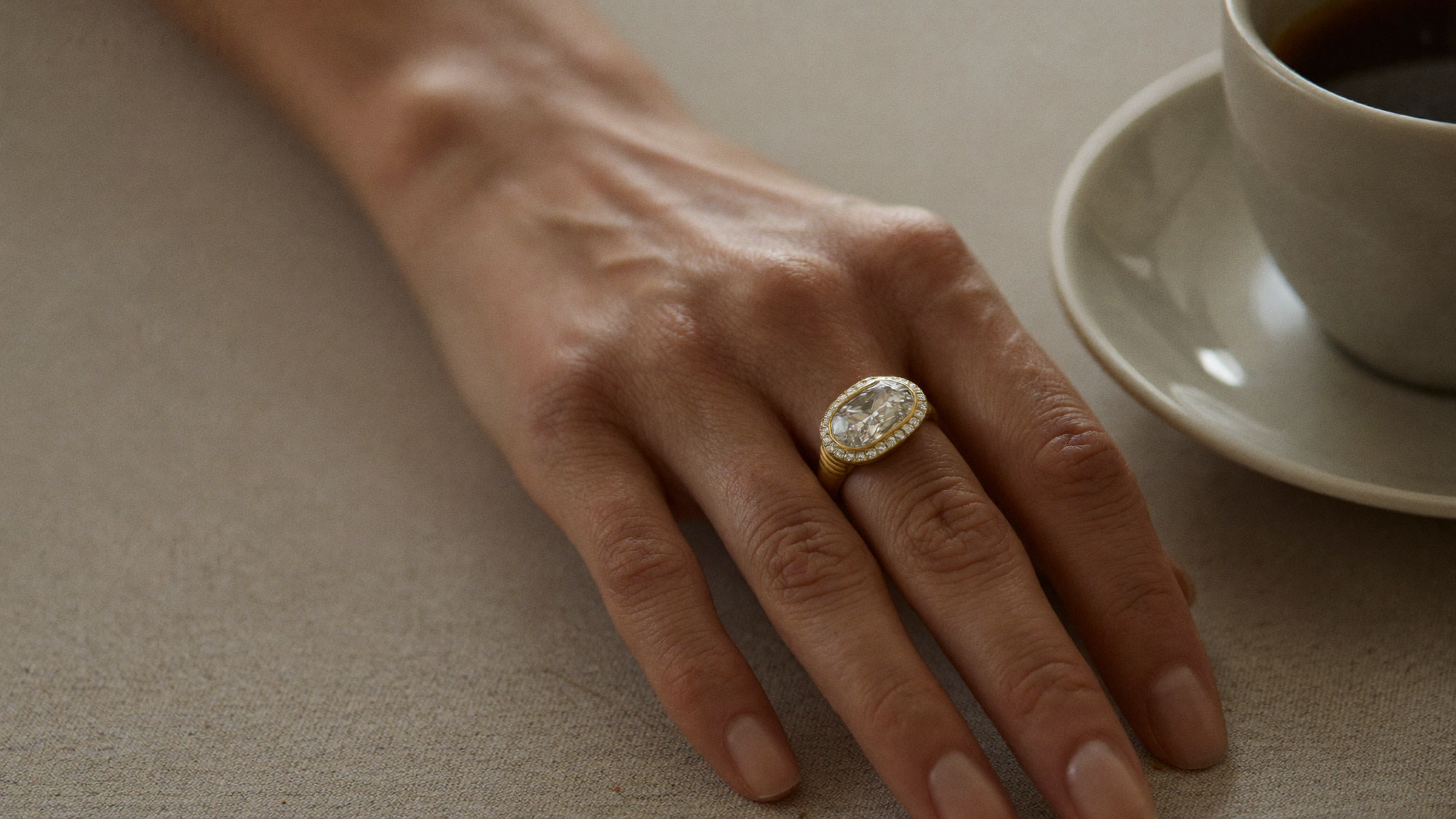
Bezel-Set Rings: No Prongs, No Problem
Somewhere in the last year, the ring world quietly split in two. On one side, diamonds still reach up toward the light on four thin claws. On the other, a smooth rim of solid gold wraps the stone completely — no prongs, no gaps, nothing to catch on a sweater sleeve. That second camp is winning, and it's not by accident.
Bezel setting isn't new — jewelers have used it for a century to protect stones on rings meant for real hands. What's new is the appetite for it. Alongside the bezel's rise, the signet ring — a flat-faced gold band built around a single set stone — has become the ring young buyers reach for first, a parallel signal that 2026's taste is moving toward quieter, more architectural shapes and away from anything that snags a scarf.
Why Bezel Set Rings Win for Everyday Wear
A prong setting holds a diamond up and out, which is exactly why it sparkles the way it does — and exactly why it's the first thing to catch on gloves, dough, or a gym bag zipper. A bezel setting encloses the stone's girdle in a continuous metal rim, so there's no edge for anything to grab. That's the whole appeal: less fuss, less risk, more ring for the years of daily wear it's actually going to see. Our Reverie Diamond Sculptural Ring (from $1,050) is the clearest example on our shelves — fluid ribbons of solid gold that bezel the diamond into the metal itself, so the piece reads as sculpture first, jewelry second.
The Low-Profile Family: Bezel, Flush, and Channel
Bezel is the most literal version of "protect the stone," but it has siblings worth knowing before you buy. Flush setting sinks the diamond level with the metal's surface — no rim at all, just the stone sitting inside the band, as in our Arc Diamond Band Ring (from $600). Channel setting runs stones between two parallel walls of gold, seen in the Linear Diamond Half Eternity Band (from $700). And bar setting, a slightly bolder cousin, holds stones between raised metal supports for more architectural presence — our Prism Diamond Band (from $800) pairs this with emerald and princess cuts for a distinctly Art Deco line. None of these settings show off a diamond quite like a prong does. All of them survive a decade of real life better.
Choosing a Diamond Cut That Suits a Bezel Setting
Round and cushion cuts bezel beautifully because their curved girdle sits flush against a rounded rim with no gaps. Step cuts — emerald and baguette — do best in bezels with precise, close-fitting corners, which is why our Prism Emerald Diamond Eternity Band (from $1,050) uses a bezel-set step-cut line rather than a rounder stone. If you're set on a marquise or pear in a bezel, ask your jeweler about a slightly thicker rim at the points — those tips are the most vulnerable part of the stone and benefit from extra metal coverage. For a deeper look at how cuts compare more broadly, see our Diamond Cut Guide, and for durability tradeoffs across metals, our 14K vs. 18K Gold guide.
Frequently Asked Questions
What exactly is a bezel setting?
Is a bezel setting more durable than a prong setting?
Do bezel-set diamonds look smaller than prong-set ones?
Can I get a bezel setting on an eternity band, not just a solitaire?
Built for the hand that actually wears it.
Every Roomy's ring is solid gold and set with an IGI-certified lab-grown diamond — bezel, flush, or prong, made to be worn every day.
Shop the Collection


