


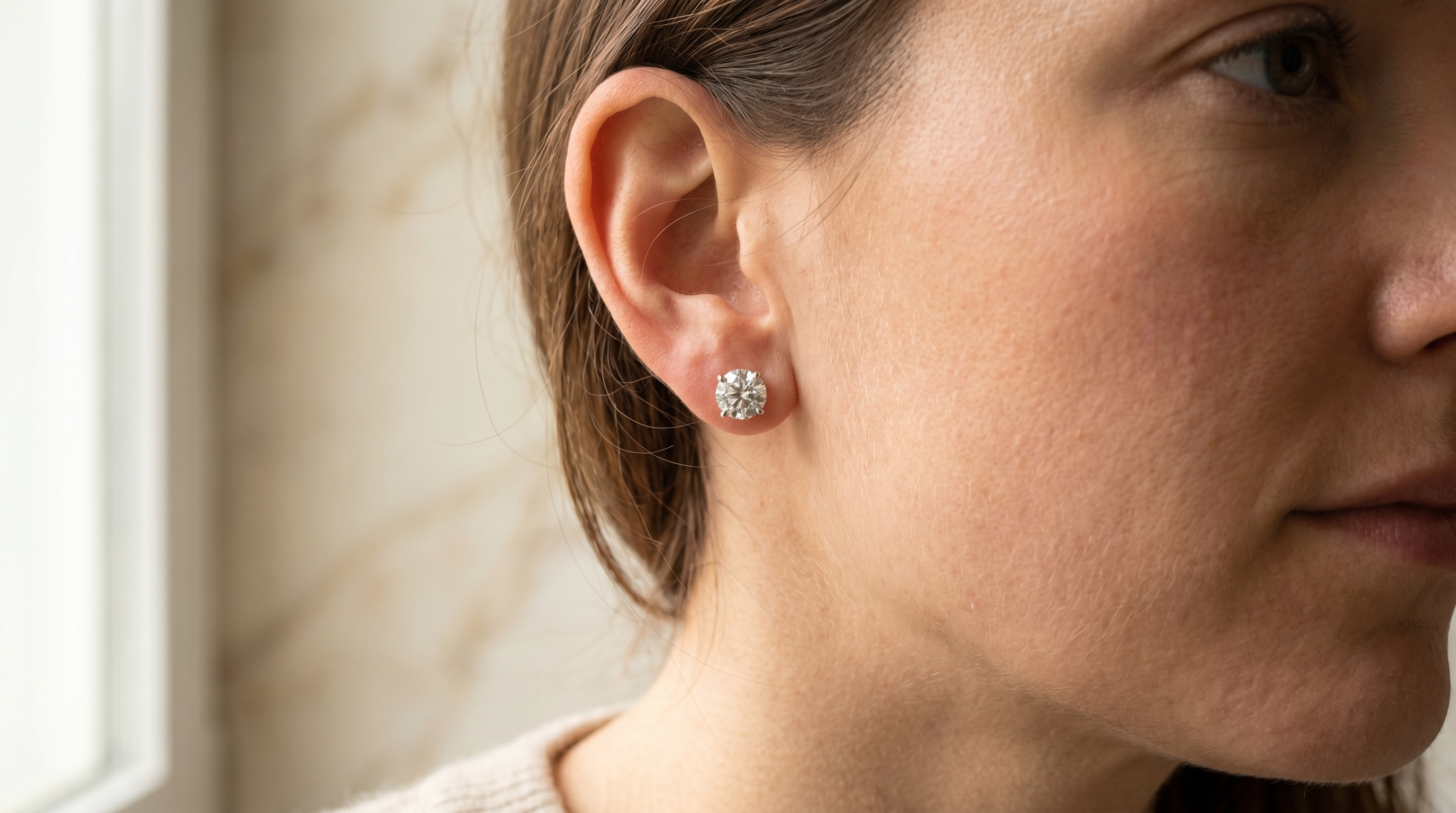
Diamond Studs, Decoded
The diamond stud is the most-worn piece of fine jewelry on earth, and the most quietly misunderstood. The difference between a stud that flashes and one that disappears comes down to four decisions, made in the right order.
Buying lab-grown diamond studs in 2026 means choosing in a market where a 1 carat total weight pair costs about what 0.5 carat total cost a decade ago. The savings invite a smarter purchase, not just a bigger one. Here is the framework.
Understand TCW Before Anything Else
Stud earrings are priced by total carat weight (TCW), the combined weight of both stones, not each. A pair labeled 1 carat TCW contains 0.5 carat in each ear. This is the single most common point of confusion in the category. When you see a price that seems too good for a 1 carat pair, check the listing carefully; it almost always means 1 carat TCW.
The Carat Size Sweet Spot
Real-world usage divides into three tiers. 0.5 to 1.0 TCW (5.2 to 6.5mm per stone) is the everyday range, present enough to catch light without snagging on scarves or pulled-back hair. 1.5 to 2.0 TCW sits on the line between daily and special occasion. 2.5 TCW and up is event jewelry; beautiful, but heavy on the lobe for all-day wear, and large enough that backs can pull through softer earlobes over time.
If the wearer has never owned diamond studs, 1.0 TCW is the safest first purchase. It is large enough to register as a real piece, small enough to wear with anything.
The 4Cs, Stud Edition
The grading priorities for studs are different from rings. Studs are viewed from the side and at a distance, never inspected up close. That means:
Cut matters most. Pay for Excellent or Ideal cut. Sparkle comes from cut quality, not carat. Color can drop a grade. G or H still face up bright white in a white gold or platinum setting; you save without visual loss. Clarity can drop further. SI1 or even SI2 with no center-visible inclusions is fine because no one inspects studs at 10x magnification. Carat is the most flexible. Use the savings to bump cut grade higher, not carat.
Settings: Four Prong vs Martini vs Bezel
Three settings dominate. Four-prong basket is the classic; maximum light entry, most brilliance, and the most secure for daily wear. Martini (three prong) sits closer to the lobe and looks smaller for the same carat weight, ideal for minimalist taste. Bezel wraps the stone in a metal rim, protecting the girdle and snagging less; popular for active wearers and athletes.
Lab-Grown Specific Notes
Lab-grown studs in 2026 come with the same IGI or GIA certification as mined. Look for a graded center stone (not just an in-house grade), and confirm the metal is solid 14kt or 18kt gold, not gold-plated. A 1 carat TCW pair of lab-grown studs, F color, VS2 clarity, Excellent cut, in 14kt white gold should sit around $700 to $900. The same in mined would be $1,800 to $2,400.
Frequently Asked Questions
Should I buy 1 carat or 2 carat for a first pair?
What metal is best for stud earrings?
Will lab-grown studs look smaller than mined?
How do I keep them secure if I wear them constantly?
Shop the Pieces
The sizes and settings covered above, ready to wear:
- Butterfly Diamond Stud Earrings, a classic 4-prong everyday stud
- Starlight Portal Diamond Stud Earrings, a bezel-set option for active wear
- Three Stone Diamond Stud Earrings, more presence at the same TCW
Keep reading: The Diamond Cut Guide 2026: Round, Oval, Emerald, Pear & Marquise Compared, 14K vs 18K Gold: Which Is Right for Your Lab-Grown Diamond Jewelry, and for a softer, on-trend look, Diamond Bow Jewelry: 2026's Coquette Trend.
The Studs You'll Wear For The Next Decade
Hand-set lab-grown diamond studs in 14kt and 18kt gold, certified, secure, and priced for daily wear.
Shop The Collection


